LFP, NMC and sodium-ion: home battery chemistry explained
The chemistry inside the cabinet decides how long a battery lasts, how it behaves in heat and cold, and how much you should worry about it.
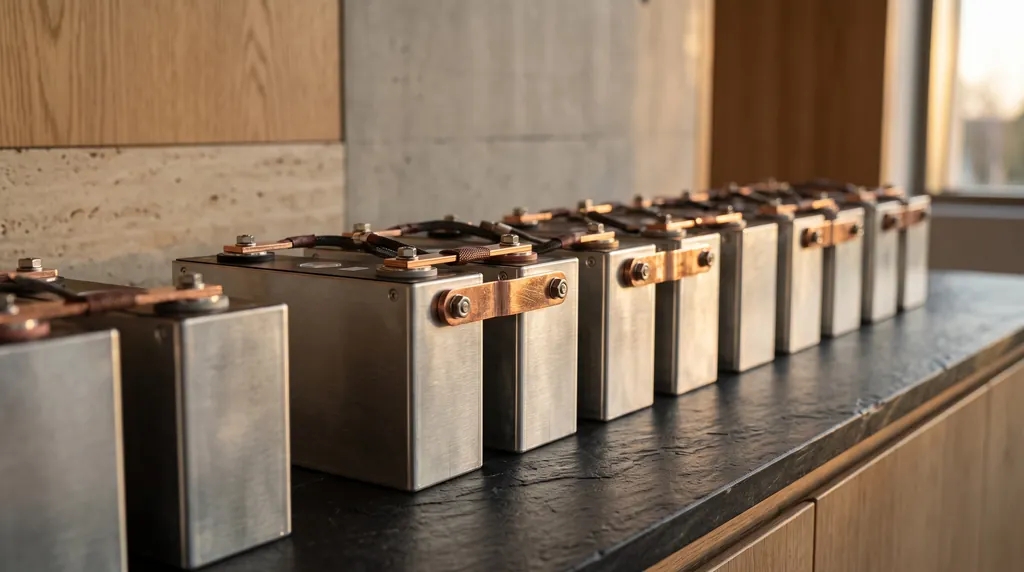

Almost every home battery installed today uses lithium iron phosphate (LFP). It stores less energy per kilogram than the nickel-based chemistries in many electric cars, but in a garage or utility room weight hardly matters. What matters is long life, stable behaviour and safety, and that is where LFP is strongest. Sodium-ion cells are now arriving as a second option, while NMC has largely disappeared from new home storage.
Lithium iron phosphate (LFP)
LFP cathodes contain no cobalt and no nickel. The iron phosphate structure holds on to its oxygen even at high temperatures, which makes thermal runaway far less likely than with nickel-rich chemistries. LFP cells tolerate deep cycling well; many manufacturers warrant 6,000 full cycles or a guaranteed energy throughput, typically over 10 years, with 60 to 70 percent of capacity remaining at the end. At one cycle a day, 6,000 cycles is more than sixteen years.
Nickel manganese cobalt (NMC)
NMC cells pack more energy into less space and weight, which is why they remain common in cars. In home storage they were popular in early systems. Their downsides there are a lower tolerance for heat, a higher fire energy, and dependence on cobalt and nickel. If you are offered an NMC home battery today, ask why.
Sodium-ion
Sodium-ion cells replace lithium with sodium, an abundant element, and use no cobalt or nickel. They keep a larger share of their capacity in sub-zero temperatures, can be stored and shipped at very low charge, and are considered thermally robust. Their energy density is lower than LFP, which again matters little in a stationary cabinet. The first stationary products reached the market from 2024 onwards; long-term field data is still limited, so warranty terms deserve a careful read.
Efficiency and temperature
A battery cell returns well over 90 percent of the energy put into it. The complete system, including the inverter and its own consumption, typically achieves 85 to 92 percent from AC in to AC out. DC-coupled systems, where the battery sits behind the solar inverter, save one conversion step compared with AC-coupled retrofits. All lithium chemistries age faster in heat: an indoor location between about 5 and 30 °C is ideal, and an unheated garage that freezes in winter will throttle charging.
Safety standards to look for
- IEC 62619: international safety requirements for lithium cells and batteries in stationary applications.
- VDE-AR-E 2510-50: the German application rule for stationary lithium battery storage systems.
- UL 9540 and UL 9540A: the North American system standard and the fire propagation test method.
Install the battery according to the manufacturer's clearances, keep it out of escape routes, and make sure the installer registers it with the grid operator where required.
Second life and recycling
Used car batteries are increasingly given a second life in stationary storage, which makes sense for large commercial systems. For a home, a new, warranted product is usually the safer choice. At the end of its life, every lithium battery must go back into a proper recycling channel; in the EU, the Batteries Regulation sets collection and recycled content obligations for manufacturers.
Questions and answers
Is an LFP home battery safe?
LFP is the most thermally stable lithium chemistry in common use and has become the standard for home storage. Look for certification to IEC 62619 and, in Germany, VDE-AR-E 2510-50.
How long does a home battery last?
Many LFP batteries are warranted for 6,000 cycles or more, usually over 10 years. At one cycle a day, that corresponds to well over a decade of use.
Written by the sunaliv editorial team. Figures are typical ranges for Central Europe unless stated otherwise and reflect the state of knowledge in October 2026. Spotted an error? Write to info@nextao.de and we will correct it openly.