Home battery sizing: how many kilowatt hours do you actually need?
Bigger is not better. The right battery is the one that fills on most days and empties on most nights.
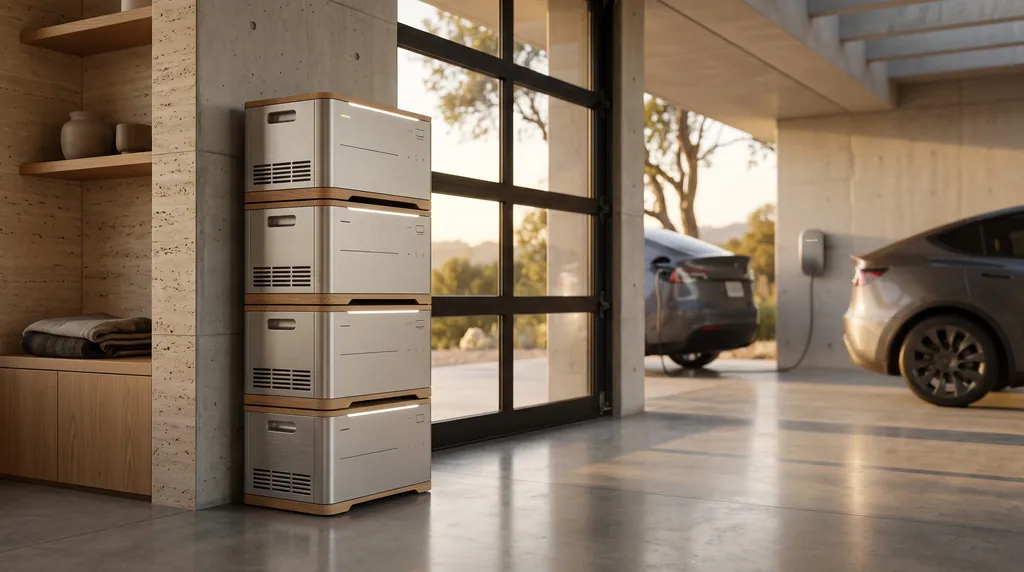

A home battery does one job: it stores solar power that would otherwise flow into the grid at midday and releases it in the evening and at night. The ideal size is the one that is full on most sunny days and empty by the next morning. A widely used rule of thumb puts it at about 1 kWh of usable capacity per 1,000 kWh of annual electricity use, and no more than about 1 to 1.5 kWh per kWp of solar. For a household using 5,000 kWh with a 10 kWp roof, that points to roughly 5 to 8 kWh.
Why bigger is not always better
Every additional kilowatt hour of storage adds less than the one before. The first few kilowatt hours cover the evening peak and are cycled almost every day of the year. Additional capacity only helps on days with enough surplus to fill it and enough night-time demand to empty it, which in Central Europe means the summer half of the year. In December, even a 10 kWp roof rarely produces enough to fill a large battery. Our home battery planner shows this curve for your numbers.
What self-sufficiency to expect
Without storage, a typical family home uses roughly 25 to 35 percent of its electricity directly from the roof. A well sized battery lifts self-sufficiency to around 55 to 75 percent. Going beyond 80 percent in Central Europe requires disproportionately large systems, because the gap left over is winter demand, and no daily battery can move June sunshine into January.
Usable, nominal and power
- Usable capacity is what counts. Some datasheets quote nominal capacity, and the system then reserves a share to protect the cells.
- Continuous power decides what the battery can run at once. 3 to 5 kW covers ordinary household loads; a heat pump, an induction hob and a kettle together can exceed it, and the rest then comes from the grid.
- Modularity lets you start smaller and add modules later, usually within a few years, while the same cell generation is still available.
Heat pumps and electric cars change the maths
A heat pump shifts consumption into winter, when surplus is scarce, so it raises total demand far more than it raises useful battery cycles. An electric car is better charged directly from solar surplus during the day than via the house battery: charging the car through the battery wastes energy twice and wears the cells. If the car is often at home during the day, a smaller house battery may be enough.
Backup power is a separate feature
Most grid-connected batteries switch off during a power cut for safety reasons. If you want the lights on during an outage, you need a system with backup or island capability: anything from a single protected socket to a full house switchover. Ask specifically, and ask whether the solar array can recharge the battery while the grid is down.
The economics in one line
Divide the battery price by its usable capacity and by the number of cycles it will realistically complete in its life. The result is your cost per stored kilowatt hour. Compare it with the difference between your electricity price and your feed-in tariff. If storage is cheaper, the battery pays; if not, it buys independence rather than savings. Both are legitimate reasons, as long as you know which one you are paying for.
Questions and answers
What size battery do I need for a 10 kWp solar system?
For a household using about 4,000 to 6,000 kWh a year, a usable capacity of roughly 5 to 10 kWh is usually sensible. Larger batteries add little self-sufficiency in Central Europe.
Does a home battery work during a power cut?
Only if it has a backup or island function. Most standard grid-connected systems switch off during an outage.
Written by the sunaliv editorial team. Figures are typical ranges for Central Europe unless stated otherwise and reflect the state of knowledge in October 2026. Spotted an error? Write to info@nextao.de and we will correct it openly.