Ventilation with heat recovery: fresh air without losing the warmth
An airtight house needs a planned way to breathe. A ventilation unit with heat recovery provides it and keeps most of the heat inside.
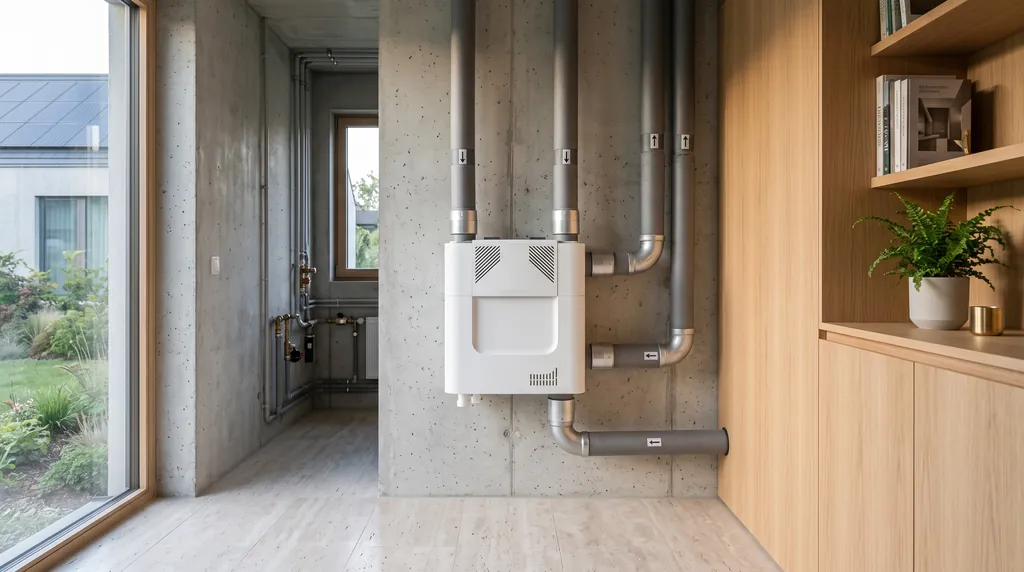

The more airtight a house becomes, the less it ventilates by accident through gaps and cracks. That is good for the heating bill, but moisture, carbon dioxide and odours still need to leave. Opening windows several times a day works in theory and is rarely done consistently. Mechanical ventilation with heat recovery (MVHR) exchanges the air continuously and passes the heat of the outgoing air to the incoming fresh air in a heat exchanger. A good unit recovers 75 to 90 percent of that heat.
How it works
Fresh air is drawn in from outside, filtered, warmed in the heat exchanger by the outgoing stale air, and supplied to living rooms and bedrooms. Stale air is extracted from kitchen, bathrooms and utility rooms, where moisture and odours arise. The two airflows never mix. Air moves gently through the house via overflow openings, often simply a gap under the doors. A typical design exchanges a third to half of the air volume every hour.
Why it matters in modern homes
- Moisture: a household releases several litres of water vapour a day through cooking, showering, plants and breathing. In airtight homes, it must be removed to prevent mould.
- Air quality: carbon dioxide in closed bedrooms rises noticeably overnight; continuous ventilation keeps it low without open windows.
- Quiet and clean: windows can stay closed on busy streets, and fine filters keep pollen and dust out.
Central or decentral
A central unit sits in a technical room and connects to all rooms through a duct system. It is the most efficient and quietest solution and is ideal for new builds and major renovations. Decentral units are installed in pairs in external walls and alternate direction every minute or so, storing heat in a ceramic core. They need no ducts and suit retrofits, but are more audible and less efficient. Enthalpy exchangers, which also recover moisture, prevent overly dry air in cold winters.
Signs of a well planned system
- Quiet operation: the Passive House Institute recommends no more than 25 dB(A) in living rooms and bedrooms.
- Efficient fans with low electricity use per cubic metre of air moved.
- A summer bypass that lets cool night air in without heating it.
- Sound attenuators in the ducts and an air flow commissioning report for every room.
Maintenance
Filters are the main task: most units ask for a change once or twice a year, and many display a reminder. Ducts in a well designed system with good filters stay clean for many years; inspection openings allow a check. The heat exchanger itself needs occasional cleaning according to the manufacturer. Done properly, an MVHR system runs quietly in the background, and most owners notice it only when they visit a house without one.
Questions and answers
How much heat does a heat recovery ventilation system save?
A good MVHR unit recovers 75 to 90 percent of the heat in the outgoing air, which would otherwise be lost through window ventilation.
Can I still open the windows with MVHR?
Yes. The system makes window ventilation unnecessary in winter, but you can open windows whenever you like, especially in summer.
Written by the sunaliv editorial team. Figures are typical ranges for Central Europe unless stated otherwise and reflect the state of knowledge in October 2026. Spotted an error? Write to info@nextao.de and we will correct it openly.