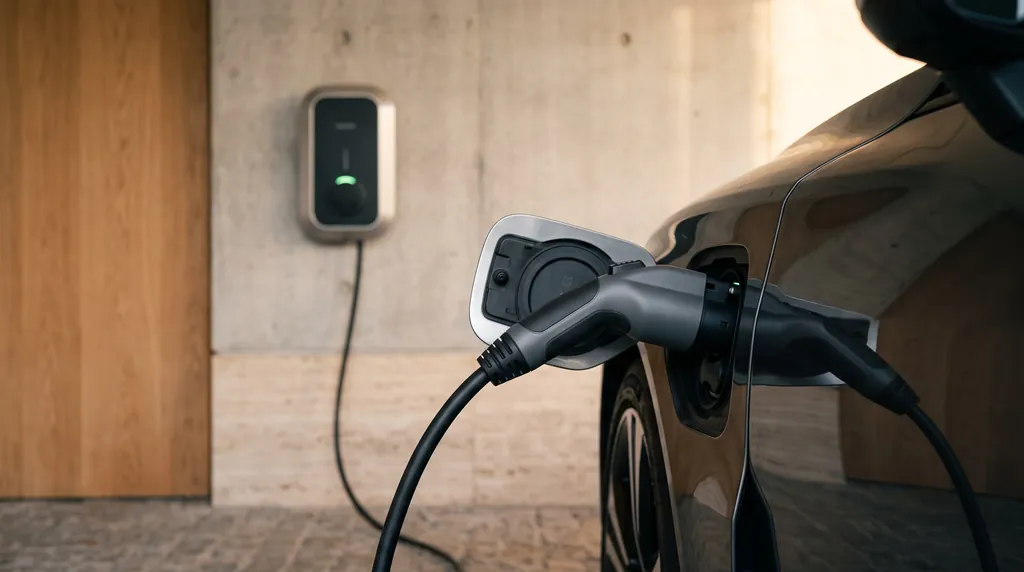
Charging on sunshine: solar surplus charging and bidirectional cars
A car parked at home on a sunny day is the largest battery the house will ever have. Here is how to fill it from the roof, and when it can give power back.
Solar surplus charging sends only the electricity your house does not need into the car. When a cloud passes, charging slows; when the sun returns, it speeds up again. The constraint is the car's minimum charging current of 6 A. On one phase that equals about 1.4 kW, on three phases about 4.1 kW. A wallbox that can switch automatically between one and three phases can therefore charge from a modest surplus in spring and autumn, and at full power on a summer noon.
How far a roof takes you
On a clear summer day, a 10 kWp system in Central Europe produces around 50 to 60 kWh. After the household's share, 30 kWh or more may be available for the car. At a consumption of 17 to 20 kWh per 100 kilometres, that is 150 to 180 kilometres of range from a single sunny day. Across the year, the picture is uneven: plenty from April to September, little in December. Most households combine solar charging in summer with cheap night-time charging in winter.
What you need
- A wallbox with surplus charging, either built in or via a home energy management system that reads the meter or the inverter.
- Ideally automatic one and three phase switching, so the window opens at around 1.4 kW instead of 4.1 kW.
- A car that is at home during the day. For commuters, weekends and home office days are when solar charging works.
- Sensible priorities: car before battery on sunny days, because charging the car via the house battery loses energy twice.
Solar carports
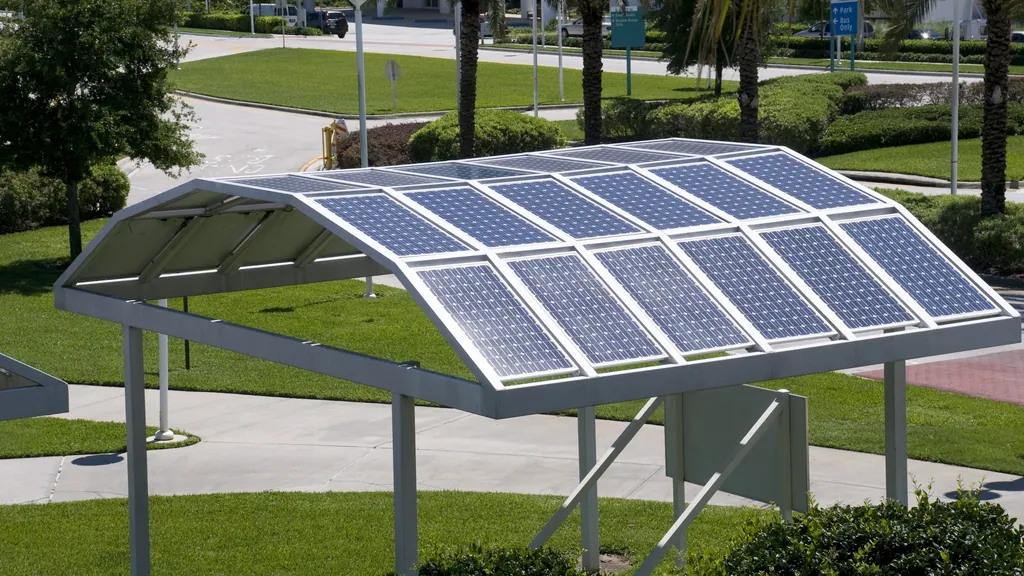
A carport or pergola covered with glass-glass solar modules turns the parking space into a power plant directly above the car. Bifacial modules gain from light reflected by the ground beneath. Carports of this kind usually need building permission like any other structure, and the electrical design should allow for the wallbox and possibly a battery from the start.
Bidirectional charging: V2H and V2G
A car battery of 60 to 100 kWh holds several days of household consumption. Bidirectional charging lets the car return energy: to the house (vehicle to home, V2H), or to the grid (vehicle to grid, V2G). Japanese cars with CHAdeMO have supported V2H for years; for cars with the European CCS standard, the communication standard ISO 15118-20 provides the basis, and a growing but still limited number of models and wallboxes support it. Before planning around it, check three things: the car must officially allow bidirectional operation, the wallbox must be certified for it, and the car maker's battery warranty must cover the extra cycles, sometimes limited to a set amount of energy per year.
A realistic outlook
Surplus charging works reliably today and is the best use of solar power for most households with an electric car. Bidirectional charging is technically ready but still depends on matching hardware, grid operator rules and tariffs that reward it. If you are buying a wallbox now, choosing one that is prepared for ISO 15118 keeps the option open.
Questions and answers
Can I charge my electric car only with solar power?
Yes, with a wallbox that supports surplus charging. It needs at least about 1.4 kW of surplus on one phase or 4.1 kW on three phases, and works best from spring to autumn.
What is V2H?
Vehicle to home means the car battery supplies the house, for example in the evening or during a power cut. It needs a compatible car, a bidirectional wallbox and the car maker's approval.
Written by the sunaliv editorial team. Figures are typical ranges for Central Europe unless stated otherwise and reflect the state of knowledge in October 2026. Spotted an error? Write to info@nextao.de and we will correct it openly.