Wallbox basics: 11 kW, 22 kW and what your car can actually take
The wallbox offers the power. The car decides how much of it to take.
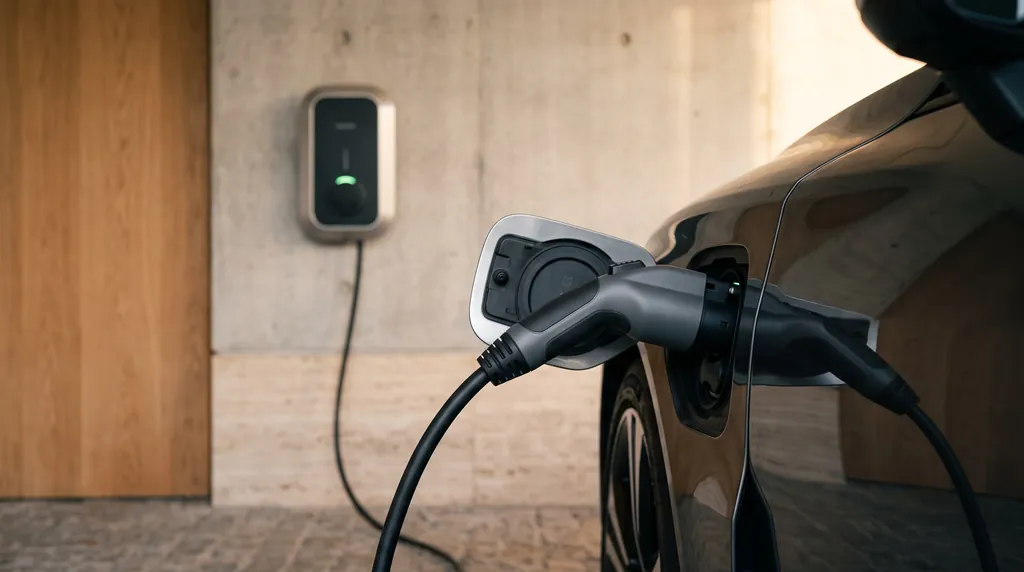

A wallbox is a protected, permanently installed charging point. Its power depends on how many phases it uses and how much current flows per phase: 3.7 kW for single-phase at 16 A, 7.4 kW for single-phase at 32 A, 11 kW for three-phase at 16 A and 22 kW for three-phase at 32 A. On AC charging, however, the converter that turns AC into DC for the battery sits in the car. Its rating, the onboard charger, decides how fast the car really charges. For many models that is 11 kW, for some 22 kW, and for a few single-phase cars only 7.4 kW.
What that means in hours
A car that arrives home at 30 percent and needs 80 percent the next morning typically needs 30 to 45 kWh. At 11 kW that takes about three to four and a half hours, comfortably within a night. Even 7.4 kW is enough for most daily routines. A 22 kW wallbox mainly helps cars with 22 kW onboard chargers and drivers who need to recharge quickly during the day. Our EV charging calculator works it out for your car.
Losses between meter and battery
Some energy is lost on the way: in the cable, the onboard charger and the battery management. On AC charging, losses of 5 to 15 percent are typical, higher at low charging power because the car's electronics run regardless of how much energy flows. Very slow charging from a household socket is therefore the least efficient option, as well as the least suitable for daily use: ordinary sockets are not designed for hours of continuous load.
Protection and installation
An electric car can produce DC fault currents that an ordinary residual current device cannot detect. A wallbox therefore needs a Type B residual current device or built-in DC fault detection at 6 mA combined with a Type A device. Installation belongs in the hands of a qualified electrician, who checks the house connection, the cable cross-section and the distance to the meter cabinet.
Registration and approval
In Germany, every wallbox must be registered with the local grid operator. Units above 12 kVA, which includes every 22 kW wallbox, require prior approval. Since 2024, wallboxes above 4.2 kW must also be controllable under §14a EnWG, in exchange for a reduced grid fee. Rules in other countries differ, so ask your installer or grid operator early.
Load management and the second car
A house connection has a limit. When the heat pump, the induction hob and two cars all draw at once, a load management system prevents the main fuse from tripping by reducing charging power dynamically. If a second electric car is likely within a few years, plan for two charging points and load management from the start; the cable runs are the expensive part of a later retrofit.
Questions and answers
Should I get an 11 kW or a 22 kW wallbox?
For most homes, 11 kW is the right choice. It recharges a typical daily distance in well under two hours, and many cars cannot charge faster than 11 kW on AC anyway.
How long does it take to charge an electric car at home?
At 11 kW, adding 40 kWh takes roughly four hours including losses. A full charge of a large battery from near empty can take six to nine hours.
Written by the sunaliv editorial team. Figures are typical ranges for Central Europe unless stated otherwise and reflect the state of knowledge in October 2026. Spotted an error? Write to info@nextao.de and we will correct it openly.