Air-to-water or ground-source: which heat pump suits your home?
One pulls heat from the outdoor air, the other from the earth beneath the garden. The difference shows on the coldest day of the year.

Both systems move heat from outside into your heating water. An air-to-water heat pump draws it from the outdoor air, a ground-source heat pump from the soil or rock beneath your garden. Because the ground at depth stays at roughly 8 to 12 °C all year in Central Europe, a ground-source system works under easier conditions on cold days and usually reaches a higher seasonal performance. It also costs considerably more to install. Which one is right depends on your plot, your budget and how cold your winters get.
Efficiency: SCOP and real life
The seasonal coefficient of performance (SCOP) says how many units of heat a heat pump delivers per unit of electricity over a heating season. Well planned air-to-water systems in moderate climates typically achieve 3 to 4 in practice; ground-source systems 4 to 5. The gap widens on frosty days, when the outdoor air is coldest exactly when you need the most heat. Field measurements consistently show that the design of the heating system, above all the flow temperature, influences the result as much as the heat source.
Ground-source: boreholes or collectors
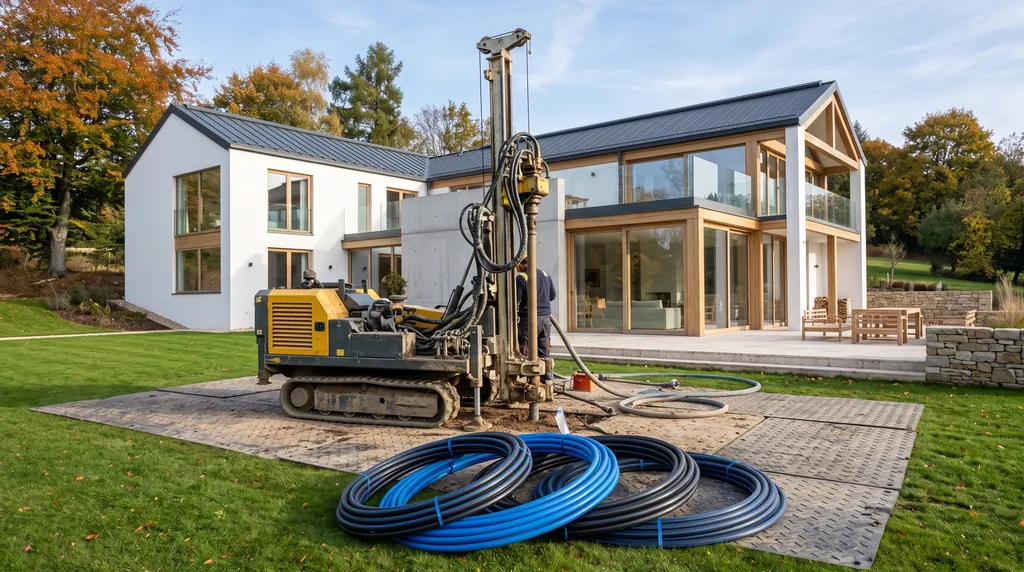
- Vertical boreholes: one or more holes, typically 50 to 150 metres deep, with a closed loop of pipe. They need little surface area, but a drilling rig must reach the garden. In Germany, holes deeper than 100 metres also fall under mining law.
- Horizontal collectors: pipe loops laid at around 1.2 to 1.5 metres depth over a large area, often one to two times the heated floor area. Cheaper than drilling, but the garden is dug up and the area must not be built over later.
- Permits: ground-source systems usually need approval from the local water authority, and some areas exclude drilling to protect groundwater.
Air-to-water: simpler, but mind the noise
An air-to-water unit needs an outdoor unit and a few square metres of space. Installation is faster and cheaper, which makes it the most common choice for both new builds and retrofits. The fan and compressor make noise, so placement matters: away from bedroom windows and neighbours, not in a corner that reflects sound. In Germany, the TA Lärm rules set night-time limits at the neighbour's window as low as 35 dB(A) in purely residential areas, and manufacturers publish sound power levels you can plan with.
Cost in perspective
Drilling or collectors often account for a large share of a ground-source project, so the system typically costs noticeably more than an air-to-water unit of the same output. The higher efficiency lowers running costs, but the payback of the extra investment can take many years. Subsidy programmes in several countries, including Germany, have at times paid a bonus for ground and water sources or for natural refrigerants; check the current rules before you sign.
Which suits your home?
- Air-to-water suits most homes with low to moderate flow temperatures, limited garden access or a tight budget.
- Ground-source suits larger homes with high heat demand, plots with access for a drilling rig, cold locations, and owners who also want passive cooling in summer through the ground loop.
Our heat pump running cost calculator lets you compare both with different flow temperatures.
Questions and answers
Is a ground-source heat pump more efficient than an air-source one?
Usually yes. Ground-source systems typically reach a seasonal performance of 4 to 5, air-to-water systems 3 to 4, because the ground is warmer than winter air.
How deep is a borehole for a heat pump?
For a single family home, boreholes are typically 50 to 150 metres deep, depending on heat demand and geology. Several shallower holes can replace one deep hole.
Written by the sunaliv editorial team. Figures are typical ranges for Central Europe unless stated otherwise and reflect the state of knowledge in October 2026. Spotted an error? Write to info@nextao.de and we will correct it openly.